The modern business environment requires rapidity, flexibility, and the availability of qualified talent without necessarily having to sign a long-term contract. Staff-as-a-service is a future-proof workforce model, which enables businesses to scale their operations on-demand, streamline their cost base, and remain flexible.
With the ability to respond to the market opportunities swiftly and stay in control, businesses can have the flexibility of staffing them and access to professional talent.
How Staff-as-a-Service Works
Staff-as-a-Service for businesses, enables access to pre-vetted professionals across various domains, including development, design, marketing, and operations. These professionals work as a team, thereby generating results without the need for permanent hiring.
Key Benefits of This Model
- On-demand team expansion
The model of flexible staffing solutions may suit organizations that want a flexible staffing approach that can effectively manage business requirements.
- Reduced hiring complexity
Avoid the complexity of the hiring process and regulatory compliance.
- Predictable cost structure
Enhance cost optimization with a predictable staffing cost.
- Faster execution
Launch teams instantly and speed up project execution.
- Immediate productivity
The resources are experienced and are involved in the project itself.
The model of flexible staffing solutions may suit organizations that want a flexible staffing approach that can effectively manage business requirements.
Staff-as-a-Service vs Traditional Hiring
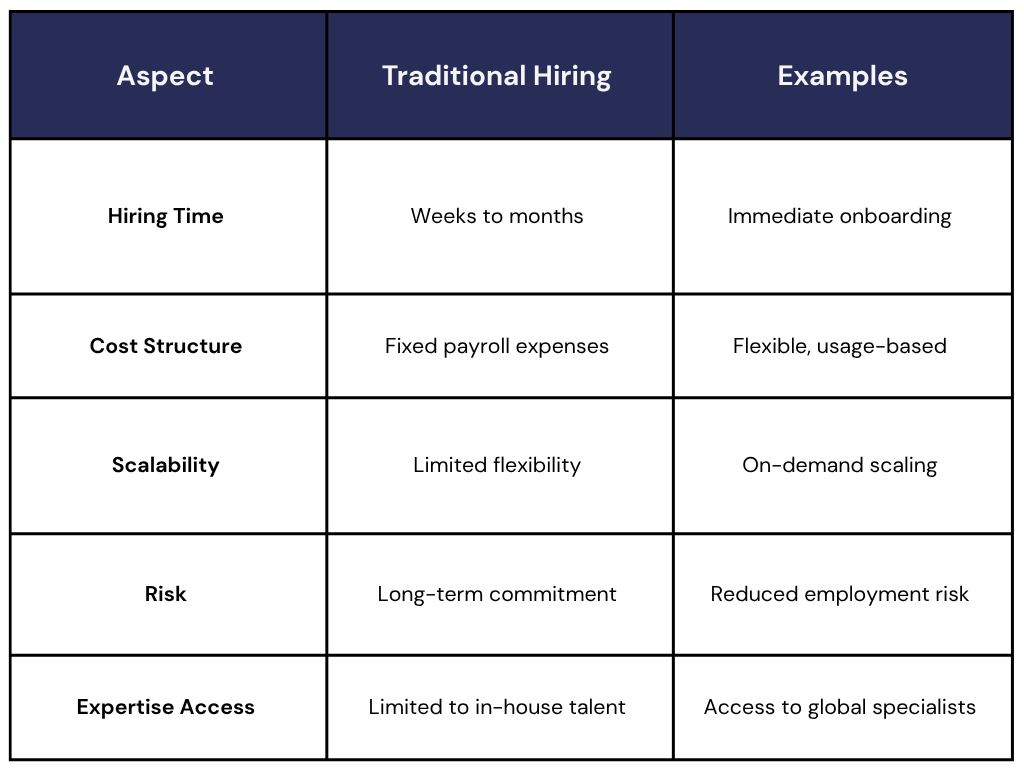
The table below identifies the major differences between the two models, i.e., Staff-as-a-service and the conventional staffing models, with regards to flexibility, cost structure, scalability, and speed of execution.
Why Businesses Are Adopting Staff-as-a-Service
The following are some of the useful reasons why companies are flocking to Staff-as-a-Service to achieve greater flexibility, lower expenses, and expand operations at an efficient scale.
1.Rapid Scaling for Growth Phases
Many businesses are in the phase of introducing new products or venturing into new markets. Therefore, they need to scale up their workforce in a short time. The staff augmentation services enable the company to scale up their workforce in a short time.
2. Flexible Support During Demand Peaks
There are cases where a company may need more staff due to seasonal demands or campaign-based work requirements. The remote staff for startups provides this kind of support without long-term commitments.
3. Access to Specialized Talent
Companies can contract professionals on part-time basis to do certain tasks like development, marketing or designing. For example:
- Hire remote developers for technical projects
- Use digital marketing staffing for campaign execution
- Leverage IT staff outsourcing for infrastructure and system support
This access improves overall output quality and project efficiency.
4. Lean Cost Management
By avoiding permanent hiring, businesses can manage costs more effectively. This approach supports better cost optimization and reduces financial risk.
5. Operational Resilience
Increased scalable teams help businesses to evolve with the varying market conditions without disturbing the workflow. This flexibility contributes to the long-term growth and stability.
Connecting Staffing with Business Strategy
The change into models such as on-demand staffing is being adopted by many organizations to keep up with competitive markets. These strategies enable organizations to match the requirement of workforce to current demands and not to rigid arrangements.
Flexible staffing backed by a well-designed staffing strategy will help in ensuring that resources are at the right place when and where required without any unnecessary overhead.
Steps to Implement Staff-as-a-Service
Businesses looking to adopt Staff-as-a-Service can follow a structured approach:
- Assess current workforce gaps
Identify areas where additional expertise or support is required.
- Define project requirements
Determine the places where more knowledge or help is needed.
- Choose the right staffing model
Select between short-term support, project-based teams, or ongoing augmentation.
- Integrate teams effectively
Align external professionals with internal workflows and communication systems.
- Monitor performance and outcomes
Measures productivity, efficiency, and ROI to optimize staffing policies.
Surveying the models such as flexible staffing options enables companies to establish scalable and efficient human resource frameworks.
Concluding Thoughts
Staff-as-a-service offers companies the chance to get their flexibility, speed, and expenses demands in their workforce administration. The model can help businesses achieve faster execution and productivity through the provision of access to skilled human resource services.
Businesses that adopt Staff-as-a-Service for businesses can enjoy the advantages of flexible growth and access to specialized human resource services. The constantly changing nature of businesses means that flexible workforce management models such as Staff-as-a-Service will help businesses remain competitive.
 :
https://www.pinterest.com/makemybrand_labs/
:
https://www.pinterest.com/makemybrand_labs/